🍒 Key takeaways
- Season: cherries are harvested from late May to mid-July depending on the variety
- Nutrition: ~60 kcal per 100 g, rich in antioxidants and natural melatonin
- Storage: 4-5 days in the fridge, freezing possible after pitting
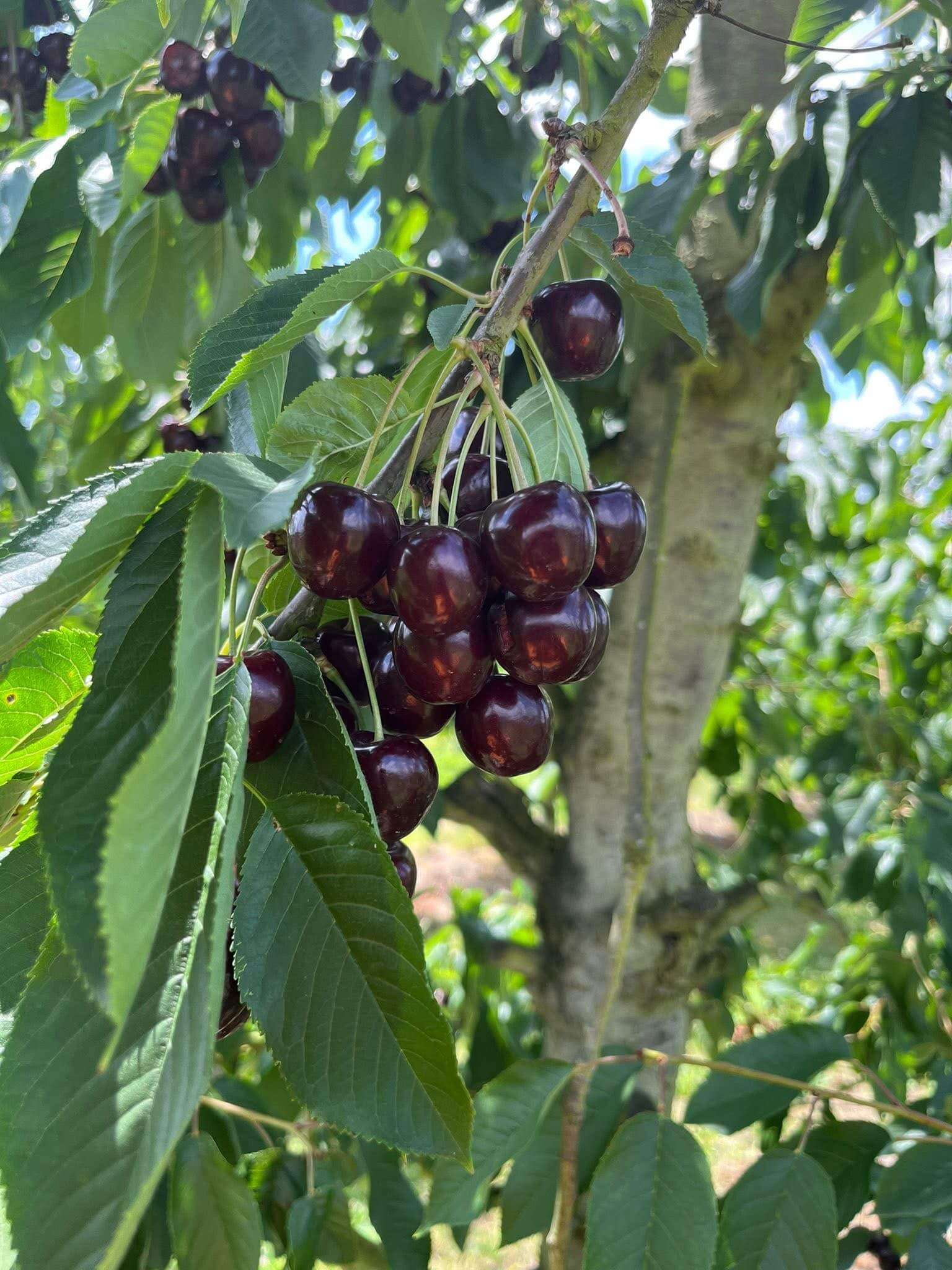
- Our variety: we grow bigarreau cherries — mainly Regina in Fernelmont: large, firm, sweet and late!
- Did you know? A cherry tree can live up to 100 years and produce up to 50 kg of fruit per season
The cherry is THE summer fruit everyone is eagerly waiting for! Small, red, juicy… and let's be honest, once you start eating them, it's hard to stop 😋 At Les Cerises de Fernelmont, we've been living to the rhythm of this little fruit for four years now. And we can tell you we never get tired of it! In this guide, we share everything we've learned about the cherry — its varieties, its benefits, how to store it, and our favourite recipes. Happy reading 🍒
The main cherry varieties 🍒
Not all cherries are equal! There are hundreds of varieties, but they can be grouped into two big families: sweet cherries (bigarreaus, the ones you eat by the handful) and sour cherries (morellos, perfect for cooking and liqueurs). Let's take a tour!
Sweet cherries — bigarreaus
These are the ones you know best. Large, fleshy, sweet, ideal to bite into directly. Most of the cherries sold at markets and in self-picking orchards are bigarreaus.
Regina, our star at Fernelmont ⭐
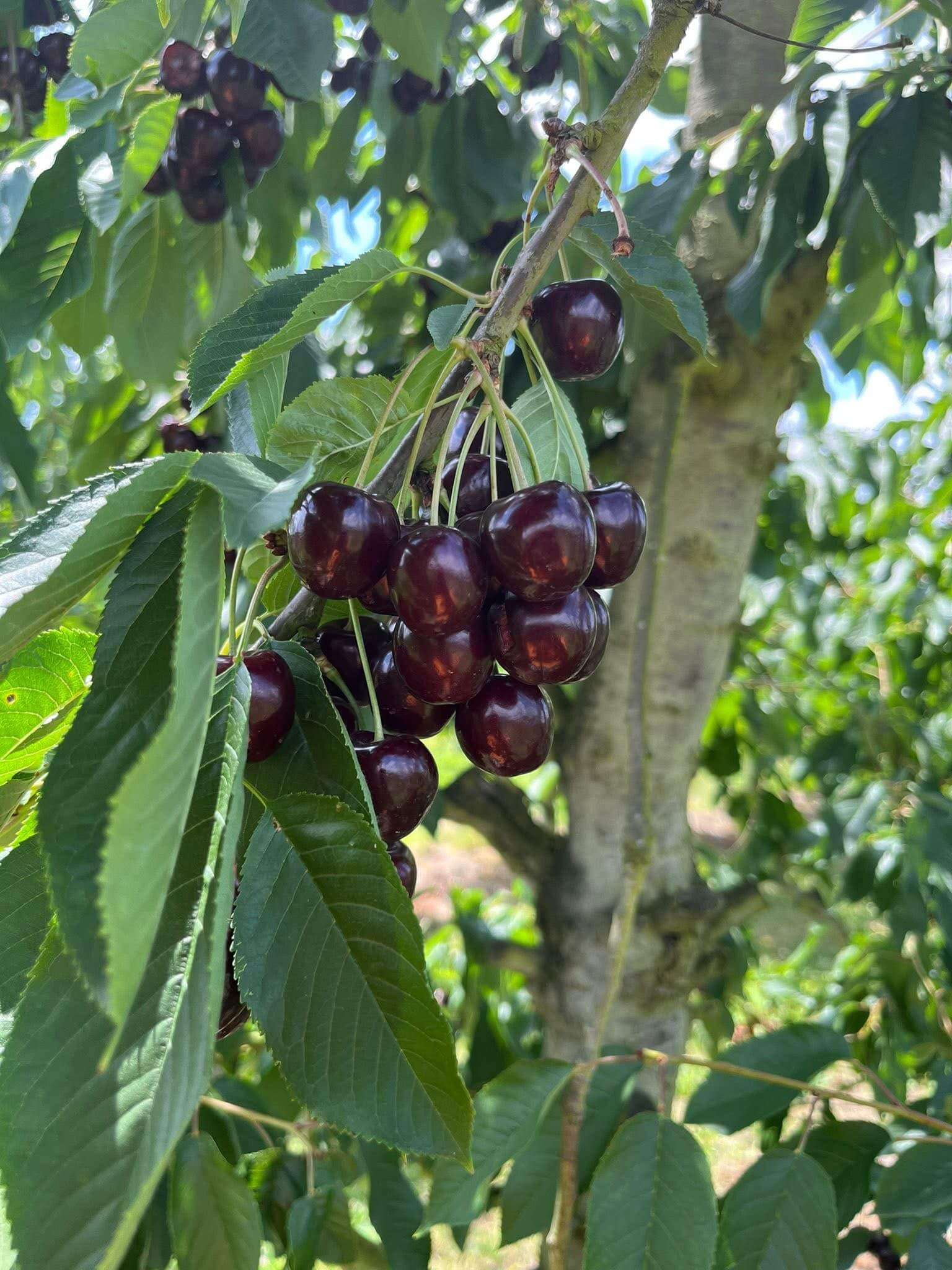
We won't lie, we have a big soft spot for Regina! It's the main variety we grow in our orchard and we chose it for very good reasons. Regina is a firm-fleshed bigarreau, sweet and juicy, with a large calibre that's a feast for the eyes. It's late (we harvest it more towards late June - early July), which means it often escapes spring frosts. And above all, it's resistant to splitting in the rain — a real asset in Belgium, we won't hide it 😄 Whether you eat them on the spot or turn them into jam, they're perfect! We've also just replanted Kordia and Areko, two other outstanding bigarreaus that will start producing in about 2 years.
Other varieties worth a detour:
- Burlat: the first of the season! It arrives from late May. Dark red, juicy, very sweet. On its own it accounts for 30% of French production. The only downside: it's fragile and doesn't store well.
- Napoleon: easily recognisable by its two-tone yellow and red skin. Crunchy flesh, mild flavour. Excellent in jars!
- Summit: very large calibre, bright red. Popular in Canada and increasingly here at home.
- Van: dark red almost black, very fragrant. A cherry orchard classic.
- Reverchon: firm flesh, large and late. Often used for candied cherries.
Sour cherries — morellos
We often forget them, and that's a shame! Morellos are smaller, tarter, but they have an intense flavour that works wonders in the kitchen.
The most famous? Montmorency, named after the French town. It's the one used for kirsch (the Alsatian brandy), for Black Forest cake filling, and for maraschino cherries. A morello with an incomparable taste!
Variety summary table
| Variety | Type | Season | Characteristics |
|---|---|---|---|
| Burlat | Bigarreau | Late May - early June | Early, juicy, fragile |
| Napoleon | Bigarreau | Mid-June | Two-tone, crunchy, ideal in jars |
| Summit | Bigarreau | Mid-June | Very large calibre, bright red |
| Van | Bigarreau | Mid-June | Dark red, very fragrant |
| Regina | Bigarreau | Late June - July | Large, firm, resistant, sweet ⭐ |
| Reverchon | Bigarreau | Late June - July | Large, firm, often candied |
| Montmorency | Morello | June - July | Tart, perfect for kirsch and pastries |
Planting and caring for a cherry tree 🌱
Want to plant your own cherry tree? Great idea! It's a rather easy tree to live with, but there are a few rules to follow if you want good harvests.
Where and when to plant?
Cherry trees love sun — they need at least 6 hours of sunlight per day. In terms of soil, they're fairly tolerant, but they hate having their feet in water. A well-drained soil, even chalky, suits them perfectly.
The best time to plant? Autumn (November-December), when the tree is dormant. That gives it all winter to settle its roots before spring. You can also plant in February-March if you missed the window, but avoid frost periods!
Day-to-day care
Pruning: the cherry tree does NOT like being pruned. Seriously, the less you prune, the better it does! If you have to intervene, do it in autumn (September-October), never in winter. Just remove dead wood and crossing branches.
Watering: an adult cherry tree does very well on its own. In the first few years, water regularly in summer, especially during dry spells. After that, Belgian rain does the job 😉
The enemies: two main opponents to watch. First, birds — they love cherries as much as we do! Protective nets or scarers, it's up to you to pick your side. And then the cherry fruit fly (Rhagoletis cerasi), which lays in the fruit and makes it wormy. Late varieties like Regina are less exposed to it, but stay vigilant.
Patience, patience…
Expect 4 to 5 years after planting before the first real harvest. That might seem long, but a cherry tree can live 50 to 100 years! It's an investment for future generations. At full maturity, a single tree can produce between 30 and 50 kg of cherries per season. Enough to treat the whole neighbourhood!
The cycle of the cherry tree through the seasons 🌸
The cherry tree is a show in every season. We never get tired of watching it evolve month after month!
🌸 Spring — the magical blossom
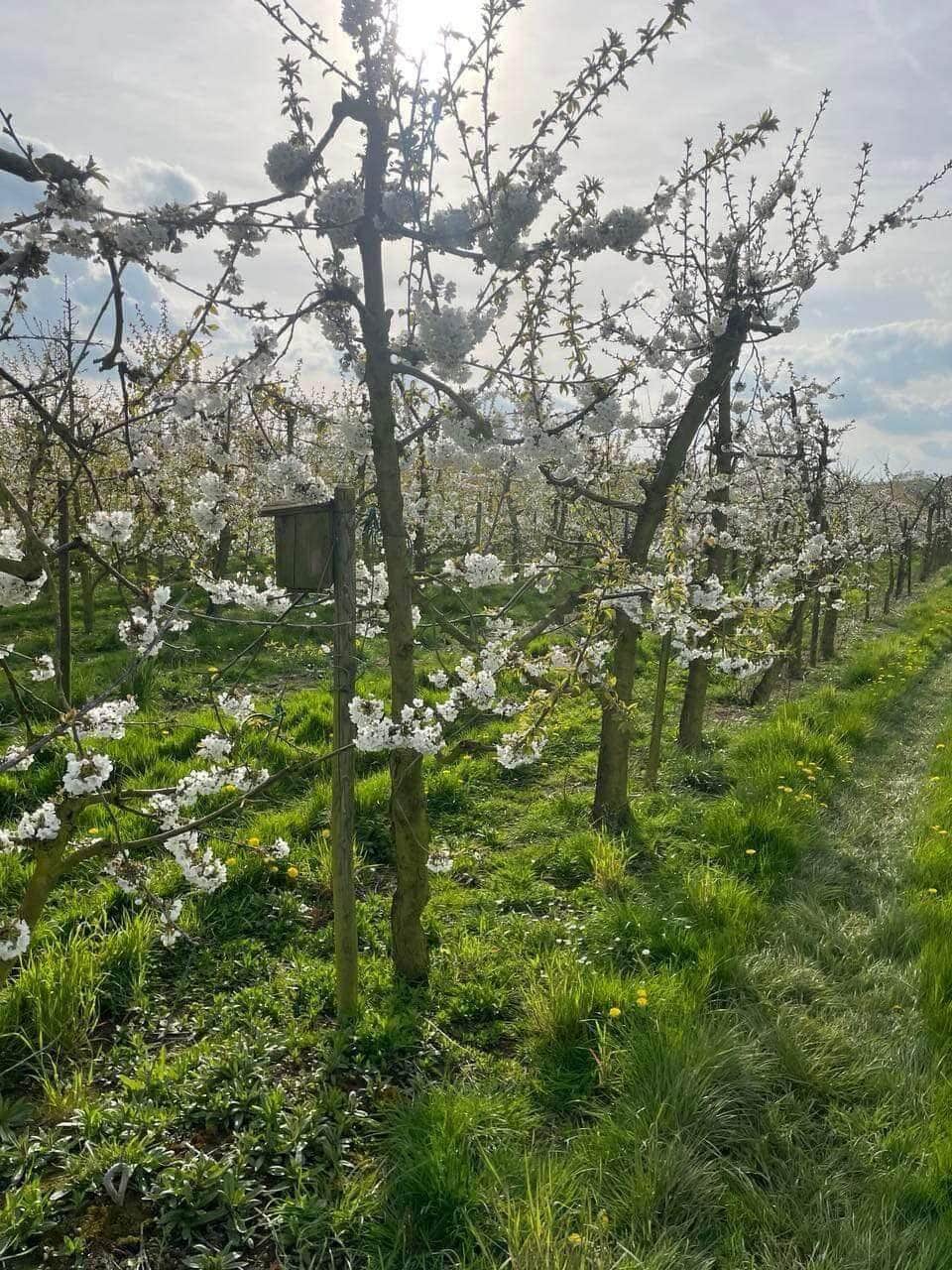
This is THE most spectacular moment. In April, the cherry tree covers itself in an explosion of white blossoms (sometimes slightly pink). We never get tired of it, even after four years! The bloom only lasts 10 to 15 days, so make the most of it. Bees and bumblebees have a field day — pollination is their job, and they do it well.
☀️ Summer — the long-awaited harvest
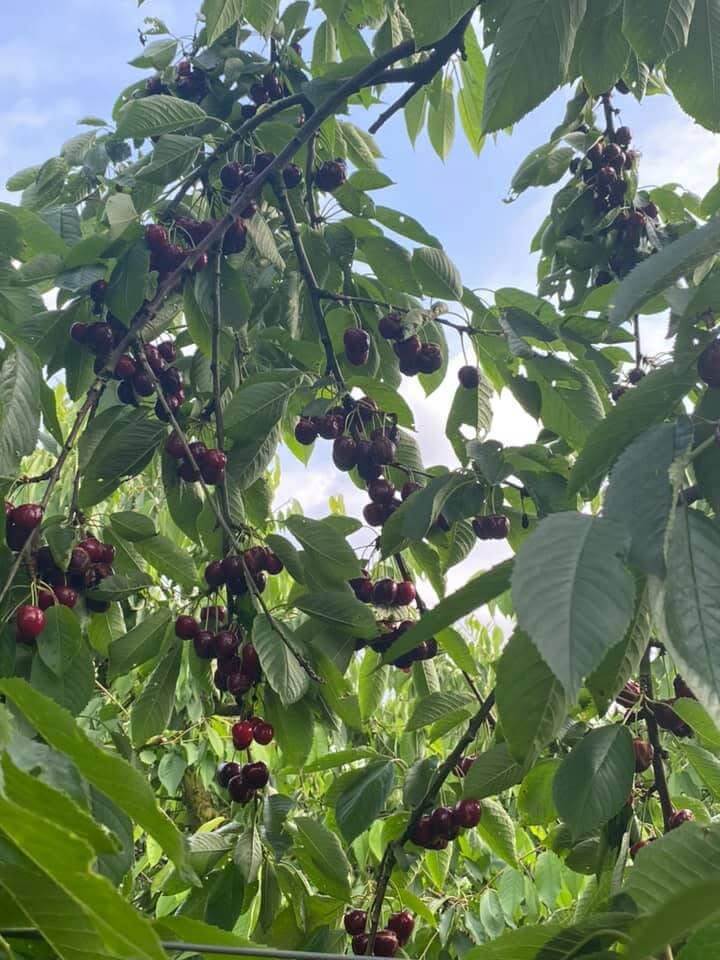
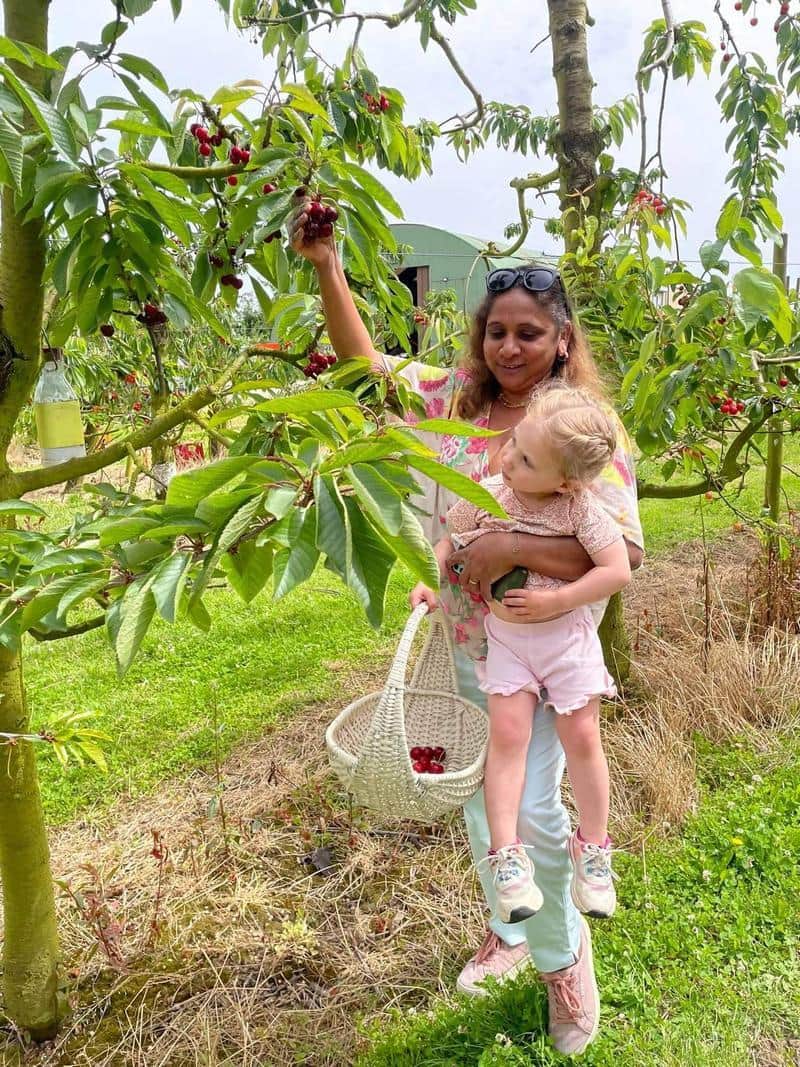
From late May to mid-July depending on the variety, cherries reach maturity. The earliest (Burlat) show up by late May, the late ones (like our Regina) keep us waiting until July. This is the self-picking period at the orchard — and we love seeing families leave with baskets bursting at the seams! Golden rule: pick with the stem, it keeps the fruit better.
🍂 Autumn — the transition
The cherry tree's leaves turn golden yellow, sometimes orange. The tree starts to slow down, it stores its reserves for winter. It's a good time to mulch the base and add a little compost.
❄️ Winter — the well-earned rest
The cherry tree goes dormant. No leaves, no visible activity, but under the bark it's already preparing for the next spring. Winter cold is actually necessary — the cherry tree needs a certain number of chill hours (between 800 and 1,200 hours below 7 °C) to bloom properly afterwards. This is called "vernalisation".
The nutritional benefits of the cherry 💪
We won't lie: when you bite into a cherry, it's first for the pleasure. But on top of that, it's a little powerhouse of good nutrients!
What 100 g of cherries contain
- 🔥 Calories: 55-63 kcal — a light fruit!
- 🍬 Carbohydrates: 13 g (natural sugars, mainly glucose and fructose)
- 💪 Vitamin C: 7-15 mg (depending on variety and ripeness)
- 🫀 Potassium: 222 mg — good for the heart and muscles
- 🌾 Fibre: 1.6 g
- 🔴 Total polyphenols: 115 mg of which 34 mg of anthocyanins (they're the ones giving the red colour!)
The superpowers of the cherry
Natural anti-inflammatory 🛡️
Cherry anthocyanins have well-documented anti-inflammatory properties. Several studies have shown that regular cherry consumption (especially Montmorency-type morellos) can reduce inflammatory markers in the body. Athletes actually use them to speed up muscle recovery after exercise!
Sleep aid 😴
The cherry is one of the rare foods to naturally contain melatonin, the sleep hormone. Sour cherries (morellos) contain more than sweet cherries. A glass of morello juice in the evening, and you sleep like a baby — or at least that's what several clinical studies suggest.
An ally against gout
This is probably the most studied benefit. Cherry consumption helps reduce blood uric acid levels, which lowers the risk of gout attacks. A study published in Arthritis & Rheumatism showed a 35% reduction in attack risk among people who eat cherries regularly.
Good for digestion
With their fibre and water content (about 82%), cherries ease digestion. Just be careful not to overdo it in one go if your stomach is sensitive — we say that from experience 😅
How to store your cherries? 🧊
You're back from self-picking with 5 kg of cherries and you're wondering how to keep them? We know the situation well — every summer we see families leaving with impressive quantities 😄 Here are our solutions!
In the fridge (4-5 days)
This is the simplest method. Put your unwashed cherries in a bowl covered with a clean cloth, in the fridge. Only wash them when you're about to eat them! Moisture speeds up spoilage. Take them out 30 minutes before eating so they regain their full aromas.
In the freezer (up to 12 months)
Freezing is THE solution to enjoy your cherries all year round! The method:
- Wash and pit your cherries
- Spread them in a single layer on a tray lined with parchment paper
- Put the tray in the freezer for 2 to 3 hours
- Transfer the frozen cherries to a bag — they won't stick together!
We wrote a complete guide on freezing cherries if you want all the details 🍒
In jars — cherries in syrup or in brandy
For lovers of homemade preserves! Cherries in syrup easily keep for a year in a cool, dark place. And cherries in brandy… let's just say they get better with time 🥃 Count on at least 2 months of maceration before tasting.
The cherry in art and culture 🎨
When you spend your days in an orchard, you end up taking an interest in everything cherry-related — including the things you wouldn't expect! And believe us, this little fruit has a whole history behind it 🍒
French expressions around the cherry
- "La cerise sur le gâteau" — the cherry on the cake, the little bonus that makes everything perfect. In English, it's "the cherry on top" — so the cherry is universal!
- "Avoir la cerise" — to be out of luck. Unclear origin, but probably linked to the red of the face when things go badly.
- "Se refaire la cerise" — to get back in shape, to regain your colours. Directly linked to the healthy red of cherries!
- "Le temps des cerises" — a happy and fleeting time. Which brings us to…
Le Temps des cerises — the song that became a symbol
Written in 1866 by Jean-Baptiste Clément, this nostalgic song speaks of love and cherries as a metaphor for fleeting happiness. But it was after the Paris Commune (1871) that it became a true popular anthem. Clément dedicated it in 1882 to a nurse of the Commune, and ever since, it has been sung every year at commemorations. A simple song about cherries that became a political symbol — who would have thought?
The cherry in painting
No wonder painters love it! Chardin painted his famous "The Basket of Cherries" in the 18th century, Cézanne his "Still life with a plate of cherries" (1885-1887), and Renoir included it in several of his compositions. The bright red of the cherry catches the eye — in an orchard as on a canvas!
Hanami — when Japan celebrates cherry trees
In Japan, hanami (literally "flower viewing") is an ancient tradition of picnicking under blooming cherry trees. Important detail: Japanese sakura are ornamental cherry trees — they don't bear edible fruit! But they do belong to the same family (Prunus) as our fruit-bearing cherry trees. Sakura blossoming is a national event, followed by millions of Japanese with dedicated weather forecasts 🌸
Tasty anecdotes
Kirsch (from the German Kirsche, cherry) is a brandy obtained by distilling fermented cherries, mostly morellos. The town of Fougerolles in Franche-Comté holds the first AOC for a stone fruit brandy. And the famous Black Forest cake, that chocolate cake with cream and morellos, comes from the German region of the same name — the Schwarzwald. Its creation is often attributed to pastry chef Josef Keller around 1915, although its exact origin is still debated. Without morellos and without kirsch, it's not a real Black Forest cake!
Our favourite cherry recipes 😋
Eating cherries plain is already wonderful. But when you have kilos of them left, here are our favourite recipes!
Cherry clafoutis — the timeless classic
The clafoutis is THE cherry dessert par excellence. A flan batter, whole cherries (yes, with the pit — it's the Limousin tradition!), 35 minutes in the oven at 180 °C and it's ready. The pit releases a subtle almond flavour while cooking.
Quick cherry jam
1 kg pitted cherries, 500 g sugar, the juice of one lemon. Boil for 20-25 minutes, stirring often. Pour into jars while still hot, turn them upside down. That's it!
Cherry-banana smoothie
200 g pitted cherries, a banana, 150 ml plain yoghurt, a few ice cubes. Blend for 30 seconds and it's ready — fresh, healthy and delicious for breakfast 🥤
We've gathered all our detailed recipes (with ingredients down to the gram!) in our article 5 easy recipes with your cherries — have a look!
FAQ — Your cherry questions ❓
When is cherry season?
In Belgium and France, the season runs from late May to mid-July. Early varieties (Burlat) arrive in late May, late ones (Regina) hold on until July. At our orchard in Fernelmont, self-picking usually opens in mid-June — keep an eye on our self-picking page for the exact dates!
Can you eat a cherry pit?
No! Cherry pits contain amygdalin, a substance that can release cyanide once metabolised. No panic if you swallow one by accident — it will pass intact. But don't crunch them, and watch children. In a clafoutis, however, the quantities are way too low to cause any problem — we don't crunch the pits, and cooking breaks down part of the amygdalin.
How many cherries can you eat per day?
A reasonable portion is around 150 to 200 g (about 20-25 cherries). Beyond that, the fibre and the naturally present sorbitol can cause digestive issues in sensitive people. That said, during self-picking season, we won't lie… we often exceed the dose 😄
What's the best cherry variety?
It depends on what you're looking for! To eat raw, Regina (large, firm, sweet) and Burlat (juicy, fragrant) are our favourites. For cooking and jams, Napoleon and Montmorency (morello) are unbeatable.
How do you know if a cherry is ripe?
Three foolproof clues: the colour (deep and uniform red), the firmness (slightly soft under the finger but not mushy), and the taste! If it's sweet and the stem detaches easily, that's the moment.
Do cherries make you gain weight?
At 55-63 kcal per 100 g, the cherry is a moderately calorific fruit — a bit more than strawberry (32 kcal) but much less than a banana (90 kcal). A 150 g portion is about 90 kcal, the equivalent of an apple. Nothing to feel guilty about!
Want to pick your own cherries? 🍒
Every summer, we welcome you to our orchard in Fernelmont for a family self-picking experience. Fresh Regina cherries, picked by your own hands, surrounded by Belgian nature — there's nothing better!
There you go, now you know (almost) everything about the cherry! From spring blossom to the last spoonful of clafoutis, this little red fruit holds no more secrets for you. And if this article has made you crave cherries… that's normal 😋 We'll see you in Fernelmont this summer!
To go further: Cherry on Wikipedia — and check our complete FAQ for all your other questions.